Showing posts with label *Fish. Show all posts

Sunday, January 22, 2017

#177 Classic Ceviche


I finally learned how to make Ceviche! It's really easy, a first grader can prepare  it easily! It is similar to one of my most favorite Filipino dishes, the Kinilaw which is also featured in this blog almost 4 years ago. Like Ceviche, Kinilaw is a dish that uses raw fish as the main ingredient and it is "cooked" not by the use of heat  but with the acid from the lemon or vinegar, and then mixed with vegetables: cucumber, daikon radish, fresh ginger, onions and spicy chili pepper. I can say now that the two are actually very different dishes. The difference is in the flavor. This is due to the avocado, cilantro, lime and orange juice sweetness in the Ceviche and it's lack of what makes Kinilaw tastes great: the intense flavor of fresh ginger and chili with every bite. I also learned that there are many variations of the Ceviche from the Americas, and I made what is considered the "Classic Ceviche", the same way it is made in the country where it originated from: Peru. I used Tuna fish, because I am a tuna girl. Haha! I am just really loyal to tuna because I am very familiar with it, I grew up in a Philippine island where  Tuna was my main red meat, and so I know how to play with its flavor...oh how I miss eating tuna at fresh catch! Good old times. Here in California, I get my tuna from the Whole Foods Market, it is wild caught and imported therefore it is a little pricier, however, you can also use sea bass, halibut or snapper. Ready to make it? Here's how.

CLASSIC CEVICHE

Ingredients:
ocean fish, cubed (tuna, snapper, seabags or halibut)
1 1/2 cups lime juice
cilantro
onions
green olives, chopped
jalapeño or serrano pepper, seeded and finely chopped
3 tablespoons orange juice
salt
pepper (optional)
ripe avocado, cubed

Directions:
  1. In a small but deep bowl, add lime juice and cubed raw fish, mix gently to coat fish evenly. Cover and set aside in refrigerator for at least 4 hours.
  2. Using a colander, drain the lime juice from the fish.
  3. In a big bowl, add the cilantro, onions, green olives, jalapeño or serrano peppers, orange juice and salt, mix well. Add the fish then mix. 
  4. Before serving, add the avocado, gently mix. Add pepper to taste (optional). 
  5. Enjoy!


It's very different from  what I expected but  is now also my favorite! I love it!

Hope you enjoyed this post! If you did, follow this blog as we will be posting 188 more recipes! 188 recipes to discover, learn to cook, take pictures and share to complete the goal of 365! 
Will I finish this task? Check back often to see my progress! xo Van


Saturday, January 16, 2016

#165 Ahi Poke


Ahhhhi Poke. This was sooo good. A little similar to Philippines' Kinilaw, but the toasted sesame seeds gave it a good twist that I oh so love.  It is a traditional Hawaiian food served in many homes,  as an appetizer. Poke is fish salad, the most popular fish used is the raw yellow fin tuna, but raw octopus, salmon and shellfish can also be used to make Poke. I was ecstatic to find gluten-free soy sauce and that's what I used in this dish.  I left out the macadamia nuts as suggested in many recipes, because of our allergy to tree nuts. Tasted great and I will be making one again very soon!

AHI POKE  
Ingredients: 
2 pounds cubed raw tuna fish steaks
1 cup gluten-free soy sauce
3/4 cup chopped green onions
2 tablespoons sesame seed oil
1 tablespoon toasted sesame seeds
1 tablespoon crushed red pepper  
Directions:
  1. Combine all ingredients
  2. Chill for atleast 2 hours before serving.
  3. Enjoy!
Recipe adapted from here


Sunday, November 10, 2013

#153 Sashimi Lemon Dipping Sauce


It takes a lot of patience to shape thin slices of raw fish into salmon roses. It was very challenging, without proper research and especially when my stomach was growling! Very little patience was left, since there's the picture taking that needs to be done. :)
The end result, is a nice image, looks nothing like a rose :/, but I did a very good job on the leaves and stem I believe, I used the wasabi paste extracted from a tube, so that part was very easy. For this recipe, I just wanted to share a really tasty dip for your sashimi, or thinly sliced raw seafood. It is very simple to make, here's how:
SASHIMI LEMON DIPPING SAUCE

Ingredients:

1/2 cup rice vinegar
1/4 cup caster sugar
1 teaspoon light soy sauce
1/4 teaspoon finely grated lemon rind
1 green onion, (green part only), chopped finely

Directions:
  1. Heat vinegar, sugar and sauce in a small saucepan, stirring, until sugar dissolves.
  2. Remove from heat, add rind; let stand for 10 minutes.
  3. Sprinkle sauce with onion.
Recipe adapted from Tasting Japan, Australian women's weekly magazine


This weekend, I learned a few do's and don'ts in Japanese etiquette, but here is what I learned about serving Sashimi:
When serving sashimi with soy sauce and wasabi on the side, it is traditional to serve the wasabi and soysauce separately, that is, not to mix the ingredients. This is because the wasabi does nothing to enhance either the flavor or sensation of the sauce. And, you don't know how much wasabi your guest wants in her/his soysauce! Leave the mixing to them.
Another important thing that I learned is, you can use your own chopsticks to take food from the communal dish if no serving implements are provided, but turn them around and use the clean handle end. Turn right way around again to use them for picking up your own food. :) Good to know!


Blogging is great. If I didn't have this blog, I don't know if I would even try making my own salmon roses! :) When I ate sashimi with friends  at restaurants, which I have- so many times, nothing compelled  me to learn more about it. I simply know it was Japanese food, raw, tastes good and then enjoyed it while catching up. None of our conservations revolved around food, it was always about our busy lives and all the crazy stuffs around us. Starting a food/cooking blog definitely opened my eyes,  I learn so much, I see food and home cooking in a different light now; cooking to me  is no longer a task, but a really fun, intimate activity at home, it helped me personally develop things within me that I didn't know I had. I am  also falling in love with food photography.  I think it is time to retire my point and shoot camera. :)

#152 Sashimi Rolls


I am a huge fan of Japanese cuisine. It is delicious, low in fat, deceptively simple to prepare, beautiful and fresh. I have always thought that the Japanese diet is a great attribute to their longevity. Their methods of cooking  have very little added fat. They consume lots of fish, and fucoidans, which are long chained molecules found in seaweed. Researchers believe that fucoidans are partly responsible for the extraordinary longevity observed in Japanese populations, where organic, unpolluted seaweeds form a significant dietary component. To embrace the Japanese diet is a no-brainer, but having cooked, photographed and posted 151+ dishes now, for me it is truly hard to stick to Japanese cuisine exclusively, especially here in the United States, there's just too many choices available. However, it is not too difficult to stick to a healthy diet. There is a saying, if it is important to you, you will make a way, if not, you will find an excuse. So if longevity is important to you, you will find a way to eat healthier, like the Japanese do. 
One of my favorites is a Japanese delicacy called Sashimi. It is thinly sliced raw seafood, traditionally served with soysauce and wasabi paste. You can use tuna, fatty tuna, squid, prawn, octopus, mackarel, snapper, white snapper and red salmon. I haven't tried prawn and octopus, yet. :) Maybe when I am bored with the fish variety, I can try eating octopus tentacles. Umm, okay, maybe just the prawns! Now sticking to red salmon and tuna, which are my two most favorite.  I found this recipe for sashimi rolls,  I loved the idea of inserting raw vegetables in each roll of the sashimi. It was fun, definitely worth all the effort because it was different and  delicious!

SASHIMI ROLLS

Ingredients:

sashimi fish
cucumber, halved lengthways
red bell pepper
green onion

japanese soy sauce
wasabi

Directions:
  1. Sharpen knife using a steel; wipe knife. Cut fish into paper-thin slices.
  2. Remove and discard seeds from cucumber and membrane from  red bell pepper. Cut cucumber, red bell pepper and green onions into long thin strips; trim strips  to approximately the same size as the width of the fish slices.
  3. Place one fish slice on board; place one or two pieces of each vegetable at one end. Roll fish to enclose filling; repeat with remaining fish and filling. Serve sashimi rolls with soy sauce in a separate bowl.
recipe adapted from Brigid Treloar, Australian Women's weekly test kitchen


Friday, June 14, 2013

#142 Philippines' Fish Paksiw


The last one of the three Bear Valley Springs trouts given to me by the Mckays, succumbed to my Paksiw craving. I badly wanted something sour or tangy, which I frequently do; I cannot live without lemons, limes, or vinegar, it's an acquired taste after over 30+ years of consuming many many sour young mangoes, sour grapefruit, and back home, dark green balimbing (starfruit) and the peeled meat of santol or faux mangoustanier in French, I don't know how to say that, but that sounds so much nicer than "santol" :) .. and you know what I use to  dip these sour fruits in?  vinegar and salt, yes more sourness until my lips turned pale! Paksiw is deliciously tangy,  so it more than satisfied my craving.  It is a Filipino way to boil and spice up fish,  with much emphasis on tanginess, so vinegar is generously poured in the mixture, olive oil and spices for flavor, and of course, not without salt. It is an easy and a really healthy way to cook fish, one of my favorites, for it's tangy and delicious flavor, it excellently pairs with rice and white wine too, and it is dangerous for the weight watchers because it is very appetizing- I tend to eat lots of rice with it. The vinegar pickles the fish, and the spices give it a nice balance; now I understand what my Tita (Auntie) Jasmin told me years ago that she loves paksiw that is flavored with spices and herbs rather than  MSG. I was an Ajinomoto MSG monster back then so I did not understand how a good flavor is achieved without monosodium glutamate, but for 7 years, I have not used it in my cooking, and we very rarely eat processed foods too,  I know it is found in many foods and some restaurants use it too so I cannot say that my body is 100% MSG free. But we do try to steer clear from it. I am not going to start a debate here whether MSG is good or bad, but I realized 7 years ago that it would be better and fun to cook the food and achieve a good flavor naturally by proper blending of herbs and spices, rather than from a sprinkle of (what I was told, which scared me, but correct me if I am wrong, please): a brain stimulant which tricks you that the food tastes so much better than it really is. For years, I have been making good Paksiw sans MSG, and only use peppercorns, garlic, onions, a good balsamic vinegar, bay leaf, vegetable base and pickled pepper. I get you now, Tita, it definitely tastes so much better. This dish is inexpensive, especially when the main ingredient is lovingly given :) and quick cooking too, great for a busy weekday schedule.
Yield: 2-3 servings
FISH PAKSIW

Ingredients:
1 medium sized fish, like milkfish, trout, golden pompano
2 tablespoons of olive oil
1 large onion
4 cloves of garlic
3/4 cup balsamic vinegar
1/2 cup water
1/4 cup fresh lime juice 
1 teaspoon peppercorn, ground
3 bay leaves
1/2 teaspoon vegetable base
3 inches long ginger, sliced
1/2 teaspoon dried dill weed
1/4 cup sliced jarred pickled jalapenos or pepperoncini
vegetables: eggplant, bittermelon, or okra (optional)
Salt and pepper to taste
Directions:
  1. Combine all ingredients except salt and pepper, boil and simmer covered until fish and vegetables are cooked. Salt and pepper to taste, discard bay leaves. Serve immediately.


Sunday, June 2, 2013

#135 Salt Encrusted Fish


The first time I saw an image of salt-encrusted fish, I was determined to find out how to make it. I still had 2 fresh fishes to cook, but I wondered if trout would be a good fish to use, I got  more curious about it. The Mckays gave me 3 fresh fishes that they caught from the well maintained and stocked community lake, and it's the freshest fish I could get from this part of the world at 5,600 above sea level. I still haven't caught my own fish, no luck so far.
This spanish style of cooking requires a lot of salt. Atleast two pounds, depending on the size of your whole fish. My advice, start with two pounds, you can always add later when you need more. Was it worth the 2 pounds of salt? Yes! Was it wasteful? Absolutely not. The money that you pay for the salt is nothing compared to the moist, delicately flavored fish that you will get- absolutely worth all the salt in your pantry and besides, salt is not expensive anyway! To those who are wondering if the Trout was good, a big yes! I think it is important to use fresh fish only, since it tastes so much better than frozen ones. Trout should be included in the list of fishes recommended for Baked Salt Encrusted Fish. It was delicious! The preparation is very simple and quick.


Here's how to make it:
  1. Clean and scale the fish. Then  pepper the insides.
  2. Stuff the cavity of the fish with the following: fresh parsley, fresh dill, and fresh lemons.
  3. Mix 2 pounds of coarse salt and 3 egg whites of large eggs.
  4. Make a bed of the salt mixture for the fish, then lay the fish on top. 
  5. Pat salt on top of the fish until it is fully covered.
  6. Preheat oven at 475 F degrees, then reduce heat to 400 F degrees and then bake fish for 20 minutes or until done.


 The salt's color turns dark when baked.


The salt crust hardens once it is done, so opening it is very dramatic! Use a knife to cut along the edges. Serve meat of fish with a light drizzle of extra virgin olive oil, pepper and some lemons if you want.
This was my first time and it was divine!!!


Thursday, May 23, 2013

#126 Trout en Papillote


We have two well-stocked, uber clean, private community lakes  for  recreation and so that  property owners and their guests can fish and eat fresh catch at 5,800 ft above sea level. It's like having a lake in the clouds filled with big fishes. Because nobody ever go fishing in the smaller lake, I assume I could sit there everyday and catch fish (If I ever will) to my heart's content. And so my fishing obsession began. Van's fishing in the mountains project, that's what I called it. Lots of free fishes to catch for our nourishment.. and for the people we love. LOL. We wished for a fishing pole for a long time, I imagined I would be able to fill the freezer with fishes, but once we finally owned one, we had no luck. I was so bad at it. LOL. It was tangled during the first day, so tangled that I had to cut it, and then also on that day, one of the cute  wild ducks got itself caught in the fishing line too, and again we had to cut it, luckily it swam out of it..what bad fishing luck we had on that day! I really wanted to catch a trout, or any fish to cook! Before we owned a fishing pole, we overheard a man who was catching fish like crazy that marshmallows are good bait. So we bought a huge bag, packed our new fishing pole, picked the spot where that man caught many fishes, and waited, I sat for a few hours, waiting for that hard tug, soon we ate most of the marshmallows, and the ones we put on the hook disappeared in minutes. No fish. We thought, better luck next time, we'll come back and fish again. Two weeks later, the fishing pole remained untouched. I almost gave up this whole "Van's fishing in the mountains project"..but then one night, we were invited to dinner, and then I learned that the Mckays (our hosts) always fish and always catch huge ones: trout, catfish, etc.  I shared our frustration, including the marshmallow bait idea, but I didn't tell them that 90% of which  ended up in our stomachs. The night went on, we played with their 3 chihuahuas, a very good dinner was served, then they told me they'll teach us how to fish..they mentioned power bait, hook, how to do this, and that...I was imagining my first catch as they were talking to me. I said I'll pay them a visit when they're fishing, they are lucky to  live across the street from the big lake. Before we went home, Sheryl gave me not one, but 3 of the big trouts that they caught. That was a really sweet gesture, and I was so thrilled to bring home the big fishes. The next day, I found myself staring at this huge trout for a long time and  had no idea know how to cook it besides grilling, which was out of the question on a very windy day. A quick search led me to a French dish called  Trout en Papillote. It had the word "trout" so I assumed it was referring to the same fish  resting on the sink, waiting to be cooked. I was excited when I found out that it simply meant, cook the trout deliciously in a foil pouch! :) I was very glad to find it, because it was an amazing way to cook fish. En papillote, means in parchment,  is a French method of cooking by placing uncooked fish, vegetables or meats inside an aluminum foil or parchment paper pouch, carefully sealed by folding and then baked, sealing it airtight will allow the  steam to cook the food. In France, they usually serve it with the fish still en papillote, and let the guests open each pouch. Great, great dish. Love the flavors of the fresh herbs and the fresh trout! Thanks to John & Sheryl Mckay.

TROUT EN PAPILLOTE

Ingredients:
 
fresh trout
1/2 cup white wine vinegar
salt
thin slices of butter
chopped fresh parsley
chopped fresh dill
white wine

Directions:
  1. Pre-heat oven to 400F degrees. Butter a large piece of foil; set aside.
  2. Clean trout, place in a shallow baking dish. Boil vinegar, pour over trout. Let stand, uncovered for 10 minutes.
  3. Drain fish. Lightly salt inside of the fish , place trout on top of butter slices in prepared foil sheets. Stuff trout with parsley and dill. Sprinkle with white wine.
  4. Fold foil around each fish, making it airtight.  Bake trout for 15-20 minutes. Salt and pepper to taste. Serve with boiled potatoes, lemon slices and horseradish cream.


I always remove scales before cooking fish, except when grilling.


Before
&
After


 This delicious dish makes me want to learn how to properly fish..
I will, soon. Fresh catch tastes the best!

Thursday, April 11, 2013

#56 Philippines' Kinilaw


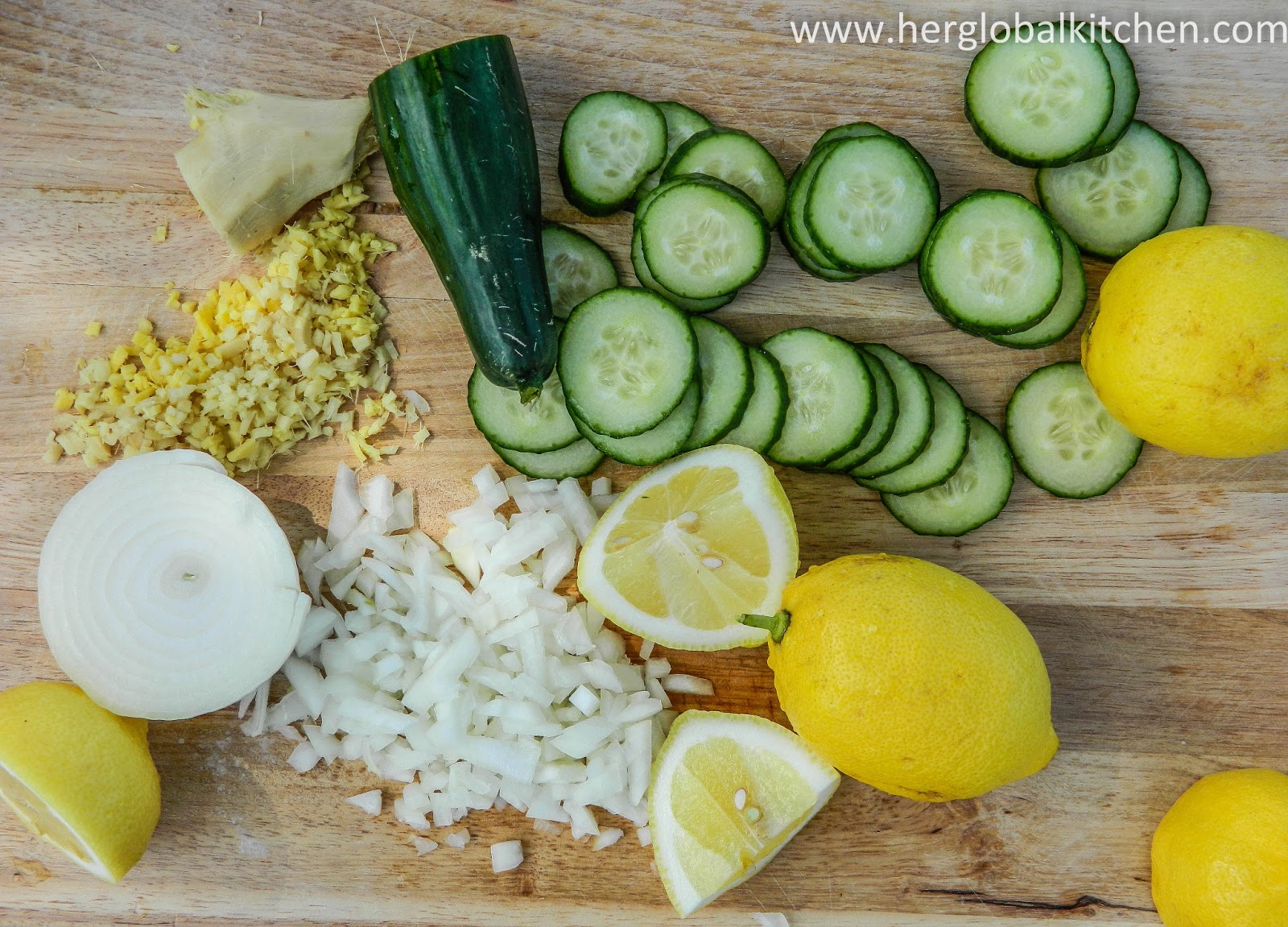
Have you tried "Ceviche?". I haven't, but my friend told me that this is similar to the Americas' Ceviche. Kinilaw is raw fish, marinated in lemons and vinegar, served with vegetables and spiced with a small but very terribly hot Philippine chili (sili). I lived by the beach back home and fresh catch tuna is always available. Fresh catch meaning small time fishermen just got to the shore, and we buy the fish literally right when the small fishing boat arrives. Fun times. After we got the fish, we fire up the charcoals, throw some really fresh tuna on the grill..belly or tail or kama (panga) , those three cuts I mentioned have best tasting meat ..yum, and then we start cutting the vegetables for our Kinilaw.


Kinilaw


Ingredients:

raw fish, preferably tuna, cut into bite-sized cubes
sliced cucumber
onions, finely chopped
ginger, minced
4 lemons (if you have calamansi, use that instead)
1 teaspoon rice vinegar
salt
pepper
chili (I used jalapeno pepper as a substitute to Philippine chili)


Directions:

  1. Add salt to raw fish meat and then marinate in vinegar and juices of 3 lemons for about 30 minutes.
  2. Combine all other ingredients, add the juice of 1 lemon. Salt and pepper to taste.
  3. Enjoy!


Tuesday, January 8, 2013

#23 Philippine's Spicy Escabeche (Sweet and Sour Fish)


SPICY ESCABECHE
(Spicy, Sweet and Sour Fish)


Ingredients:

Red Snapper (fried)
2 tablespoons vegetable oil
4 cloves of garlic, minced
1 yellow onion, chopped
3 tablespoons thinly sliced fresh ginger
2 stalks sliced green onions
1 cup Sweet Chili Sauce
1/4 cup water
1/3 cup all purpose flour
Salt and Pepper to taste


Directions:

  1. Clean the fish thoroughly and fry until golden (not crispy).
  2. Heat 2 tbsps. vegetable oil in medium heat.
  3. Sauté garlic until golden brown, and then add the onions until transparent.
  4. Add the sweet chili sauce, water, flour. Mix well.
  5. Add the fried fish. Bring to boil.
  6. Lower the heat and then add ginger and green onions and simmer it for 10 minutes.
  7. Add salt and pepper to taste.


Days before the New Year's Eve, my-sister-in-law  Neann and I were emailing each other about lucky foods  to make for a prosperous new year. Filipinos believe so much in "swerte" which means "lucky" and "malas" which means "bad luck". So immediately I googled: new year lucky foods. Found PIG, FISH, GREENS and BEANS. I found out also that not only do Filipinos and people from other countries in Asia believe it, it is also widely observed in a lot of European countries. She said she is making "Escabeche" which is "filipino sweet and sour fish", it is a great dish to make for dinner, so I told her I will be making it as well. I am not a superstitious person, I moved out from my parents' home almost 17 years ago, and have never done anything special with foods to make it lucky or put lucky objects to invite good luck in my home..since every one in my immediate family and a lot of people do it, I thought why not do something "lucky" this year for a fun change. I quickly went shopping for "lucky" foods in the afternoon of 31st of December. LOL. I'll be very lucky this year since I made ALL the lucky foods to make for the New Year's Eve dinner. I found a huge list online (including buying 12 kinds of round fruits). I went over board with the preparation and fell asleep before midnight. Hahaha. Well, the next day, we had so much of left overs and bottles of champagne unopened. I guess the good luck started pouring in immediately since we did not wake up to January 1st having the worst hang over and we had more to enjoy for a few days. :)